August in the Apennines has a particular sound: car doors, a lot of them, and a queue at the refuge counter when you would rather be eating. Go three weeks earlier or five weeks later and the same ridge can feel like your own private edge of the world. Spring and autumn ask a bit more of you — a second look at the forecast, a fleece in the pack, a plan B for the fog — but they give back a mountain that is quieter, greener or golder, and far more forgiving underfoot than the hard-baked summer trails.
Why the in-between months suit these mountains
The Apennine spine is not the Alps. Its high ground sits mostly between 1,500 and 2,900 metres, which means the transition between winter and summer happens gradually, and the window where everything lines up is wide. From mid-May to mid-June the woods are still fresh, water runs, and the big plateaus are usually free of snow below about 1,700 metres. From mid-September to late October the beech turns, the light softens, and the heat that makes a shadeless ridge unpleasant in July has gone.
What you trade is certainty. Spring brings late snowfall at altitude and mud in the shade; autumn brings rain, early dusk and valleys that fill with cloud while the ridge sits in sun. Both seasons thin out the traffic on the roads and in the rifugi, and both are easier on legs that have not been walking uphill since last year.
Monti Sibillini: the Piano Grande and Castelluccio
The great plateau below Castelluccio is the gentlest introduction to shoulder-season walking in the Apennines: a wide, almost treeless basin at around 1,270 metres with Monte Vettore rising at the far end. The circuit of the piano takes roughly two to three hours at an unhurried pace, almost all of it flat, on farm tracks and grassy paths that link the villages and the old stone bothies.
In late spring the basin is still holding meltwater in places, and the fields move from green to a soft, luminous yellow-green before the famous lentil flowering arrives in early summer. Autumn is arguably better: the ground turns to dark, ploughed earth and the whole basin reads like a desert with a village dropped into it. Either way it is exposed. Wind is the constant, and there is no shade for the middle hours of the day.
Abruzzo: Val Fondillo and the beech woods
Above the village of Opi, in the Abruzzo, Lazio and Molise National Park, the Val Fondillo runs south into the mountain on a broad track that follows the river through beech forest. It is a walk you can make as short or as long as the day allows, with side paths peeling off to clearings and old charcoal terraces, and it stays walkable in exactly the months when the high ridges are unreliable.
In spring
Snowmelt keeps the stream loud and the ground damp, which brings out orchids and hellebores along the edges of the track. The beeches leaf late here, so early May still looks like winter with better lighting. Expect mud in the first kilometre and a cool wind in the clearings.
In autumn
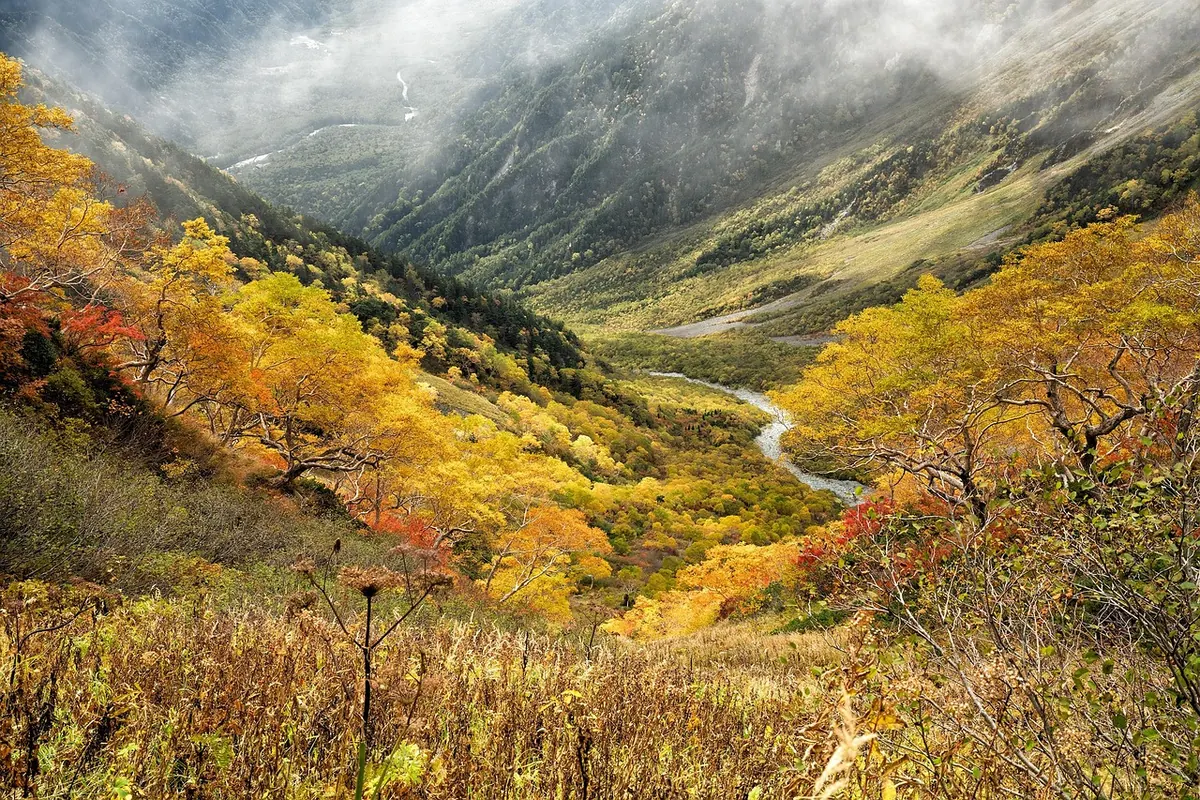
This is the valley's best season. The beeches turn copper and gold in the second half of October, and the forest floor goes quiet underfoot. It is also bear country: keep food sealed in your pack, never leave scraps at a picnic spot, and if you see a Marsican brown bear, give it room and let it leave first. Sightings are rare and that is how it should stay.
Gran Sasso and Monti della Laga: plateau and valley
Campo Imperatore is the showpiece — a high, bare plateau at around 1,800 metres reached by a road that is usually clear from late spring but can be closed by snow at any time outside summer. A short circuit on the floor of the plateau, or the modest climb to Monte Bolza above Fonte Vetica, gives you big views without committing to the summit ridges, which hold snow well into May.
Lower and more sheltered is the Valle del Chiarino, on the northern side of the massif, where a track leads up through beech woods to Lago di Provvidenza. It is a steady climb rather than a technical one, and it works well in late spring when the plateau is still white and in October when the woods are turning. In the Laga, the beech forests above Ceppo and the long approach to Monte Gorzano offer the same combination of quiet paths and serious weather above the treeline.
Majella: the Valle dell'Orfento
Near Caramanico Terme, the Orfento has cut a gorge through limestone that is crossed and recrossed on wooden walkways: a three to four hour round trip through a cool, narrow world of water, moss and grey rock. In spring the river is high and impressive; in autumn the gorge holds the last of the warmth and the maples come into their own.
It is also popular enough that the park manages access at busy periods, so check the current rules before setting out and start early. Sections of the route are exposed and slippery after rain, and the walkways demand a little care rather than any technical skill. Pair it with a short visit to the hermitage of San Bartolomeo in Legio if you want to make a full day of it.
Foreste Casentinesi and the Tusco-Emiliano ridge
The forests that straddle Tuscany and Emilia-Romagna are the quietest option on this list. From the Passo della Calla, the ridge path to Monte Falco is a straightforward walk on the border, with the Romagna plain falling away on one side and the forested interior on the other. Deeper in, the Foresta della Lama is all old beeches, forest roads and the sense of a place that has been managed patiently for a very long time.
Further north, above Pievepelago, the circuit of Lago Santo Modenese and the onward path toward Monte Giovo make a good autumn day: a lake, a ridge, and a rifugio that still opens at weekends well into October. September and October are also the deer rut, which means noise in the woods at dawn and dusk. Walk quietly, keep your distance, and do not try to get closer for a photograph.
Trail conditions and the small print
Shoulder-season walking is mostly about small decisions made in the right order. A routine that works:
- Read a mountain forecast, not a city one. The Apennine weather services give wind, freezing level and precipitation by zone; a coastal forecast tells you almost nothing about a ridge at 1,800 metres.
- Ask about snow, don't assume. North-facing gullies in the Gran Sasso and Majella can hold snow into late May. A short call to a rifugio or the local park office settles it faster than a webcam.
- Check rifugio opening. Many close for good in mid-October and reopen in June, with weekend openings either side. Water points and fountains may be turned off outside the season.
- Note the hunting calendar. The main season generally opens in mid-September and varies by region and species. Wear something bright, stay on marked trails, and be a little more careful about dawn and dusk in areas where hunting is permitted.
- Watch the daylight. A five-hour walk that finishes at seven in June finishes in darkness in October. Carry a headtorch even if you plan not to need it.
Autumn leaves are the other practical issue: they bury painted trail markers and hide loose stones. Download an offline map, and if a blaze has not appeared for several minutes, turn around and re-find the last one rather than pushing on hopefully.
Planning a shoulder-season trip
Base yourself in a valley village rather than up high — Caramanico, Opi, Castelluccio, Badia Prataglia — so that a bad-weather day costs you a short drive rather than a whole plan. Many trailheads have no public transport at all, so a car is usually necessary; where there is a bus, it tends to run with school terms rather than walkers in mind. Start early, especially on autumn Sundays when the popular car parks fill by mid-morning.
Pack for two seasons in one day:
- Waterproof shell and a warm mid-layer, whatever the morning looks like
- Hat and gloves for spring mornings above 1,500 metres
- Ankle boots with decent tread, plus poles for wet descents
- Plenty of water and a backup filter or tablets, since seasonal fountains may be off
- Offline maps, a headtorch, a small first-aid kit and a tick check at the end of the day
Book rifugi a few days ahead rather than weeks ahead, and confirm by phone the day before. Spring and autumn are when these mountains are at their most generous; they simply ask you to look at the forecast twice, leave the summit for another year if the cloud is down, and enjoy a trail that has room on it for once.
Photo: Kanenori / Pixabay